This royal throne of kings, this sceptred isle, This earth of majesty, this seat of Mars, This other Eden, demi-paradise, This fortress built by Nature for herself Against infection and the hand of war, This happy breed of men, this little world, This precious stone set in the silver sea, Which serves it in the office of a wall Or as a moat defensive to a house, Against the envy of less happier lands,-- This blessed plot, this earth, this realm, this England. ~~William Shakespeare, Richard III


Showing posts with label titanic. Show all posts

Tuesday, February 21, 2012

Life Onboard Ship: Titanic's First Class

As the 100th anniversary of the sinking of the RMS Titanic looms closer and closer, I am continuing in my posts about the ship. My first can be found here and is a "short" history on the Titanic. For this post I thought it would be fun to look at what life would have been like during the voyage for the lucky first class passengers. There are not many surviving pictures of the interior of the ship (the ones that are around were mostly taken by passenger Frank Browne) so I will use the ones I can find.

She had 1,343 passengers on board for her maiden voyage. 325 of them were in first class and resided in the most luxurious accommodations of the day, mostly in the upper decks, while the 706 in steerage (third class) were crammed into small rooms towards the very bottom and back of the ship. While Titanic wanted to cater to the fabulously rich, she actually carried more passengers in her second and third class areas (though you must remember that second class on Titanic was better than first on other ships, and third was equal to what second class was on other liners). I wish I had a good image of the Titanic's deck plans so you could see how the ship was sectioned off but I haven't been able to find anything online where the images are big enough for you to actually make out what's in them. First class passengers could pretty much go wherever they wanted to on the ship. Second class had basically the same freedom. Steerage passengers, however, were confined to their areas of the ship only and there actual locked gates to keep them in their place (these gates eventually caused significant problems the night of the sinking).

Titanic's interior was extremely lavish and White Star spared no expense in fitting her out with every luxury imaginable and every modern convenience (there were even flushing toilets on the ship, which was something most homes at the time still did not have). The most expensive staterooms a first class passenger could purchase for the voyage were the parlor suite rooms which ran about £870 ($69,600 today!). These suites (one on each side of the ship) had several rooms and their own private promenade deck (remember the scene in the movie the morning after Rose's character dances in third class with Jack?). They were called the "Millionaire Suites."In comparison, a third class ticket was £3 to £8 ($172 to $460 today) so you can see how very different the lives of these people were at the time. There were 67 other first class suites and staterooms available and they were all extremely luxurious and comfortable.
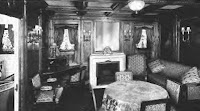
Picture of one of the Parlor Suite rooms

Besides their sumptuous rooms, first class passengers had many other marvelous and luxurious places to spend their time. Titanic was the first ship to have a swimming pool on board. There was also a Turkish Bath (like a sauna) next to the pool, which was considered one of the ship's most opulent areas. It was comprised of a steam room, hot room, and temperate room, shampooing rooms and toilets, and a cooling room. There was an extra charge to use the Bath and it was only available to first class passengers. Both of these were on F deck. Titanic also had a "state of the art" gymnasium on board, which was right off the Boat Deck. It had an electric camel, an electric horse, rowing machine, and cycles (I'm not entirely sure what those first two are!). There was an extra charge to use this as well. Besides the gym and pool there was also a Squash Court available for exercise, though I doubt many of the first class passengers actually used any of them.

Swimming Pool
Turkish Bath

Gymnasium

There were many rooms for just sitting back, relaxing, and chatting as well. The First Class Smoking room on A Deck was for men only while the Reading and Writing Room, also on A Deck, was for the ladies. There was also the First Class lounge (or library) on A Deck and the Reception Room just adjacent to the First Class Dining Saloon on D Deck. Passengers could retire to these rooms in the evening for a drink or a smoke or just to relax and gossip. Relaxing was what the first class passengers wanted to do while showing off all their finery. Women went through several clothing changes during a day, leading up to their fanciest attire being pulled out for dinner. Men probably spent a lot of their time drinking and smoking and discussing all the money they were making. It really was a charmed life on board for these elite passengers.

First Class Smoking Room

First Class Reading and Writing Room
Picture of the First Class Lounge/Library

When first class passengers were hungry they had several options. They could go down to D deck and dine in the First Class dining saloon (which spanned the width of the ship). If they wanted to stay closer to their cabins they could have a meal in the Verandah Cafe, on A Deck, or the Cafe Parisian (with authentic French waiters) which was adjacent to the A la Carte Restaurant on B Deck. Passengers most likely had to pay for their meals at the cafes and restaurant. You may remember scenes from the movie which feature some of these rooms (they are in the Verandah Cafe when Cal orders Rose the lamb and there are several scenes in the dining saloon).

First Class Dining Saloon

Cafe Parisian

Verandah Cafe

The variety of food served to the first class passengers blows my mind! And not just WHAT they ate but HOW MUCH they ate! I really don't know how the women ate anything in the clothing they wore! But what delicious looking meals they had! A few menus from the Titanic did survive the sinking and they show us what many passengers had for their last meal. Can you imagine a ten or eleven course dinner? While some of the menu items sound so very tasty there are a few that make me cringe a little bit! Baked apples, fresh fruit, Quaker Oats, Grilled ham, and omelets for breakfast sound great but I'm not too sure about mutton kidneys! I could dig in to a lunch of vegetable dumplings, potatoes, custard pudding, and Virginia ham but I just don't think I could stomach corned ox tongue. As for dinner, chicken, filet mignons, potatoes, peas, rice, eclairs, and ice cream would make me happy! Before any meal a bugler would go from deck to deck sounding the traditional meal call and passengers would make their way to their dining saloons.

First Class Breakfast Menu from April 11, 1912

First Class Luncheon Menu from April 14, 1912

First Class Dinner Menu from April 14, 1912 (the last meal for so many)

For the first class passengers, Titanic was as luxurious as a hotel in Paris or New York, a true floating palace. It is quite sad that all that fantastic work ended up at the bottom of the North Atlantic.

My next post will be about life on board Titanic for the second and third class passengers.


Friday, January 20, 2012

RMS Titanic: A Short History


April 14-15, 2012 will mark the 100th anniversary of the Titanic striking an iceberg and sinking in the North Atlantic. Has it really been that long? My interest (obsession) with the Titanic began when I was really, really young and I happened to watch the National Geographic special on the discovery of the ship by Robert Ballard which my grandparents had on VHS tape. I was hooked. Why I could not tell you! Even now I have no idea how such a show on such a subject appealed to my child's mind. I got my first book on the Titanic in the fourth grade (its actually still at my parents'!). I was thrilled when the James Cameron film came out in 1997; not for the "love story" but for the sets that were created. I was so excited to "see" the interior of the ship which I had only seen in a few black and white photos. I've been wanting to write something about the Titanic and I thought the weeks leading up to the actual anniversary would be a good time to post about my first historical interest. I'll start with the basic story (history) of the ship and we'll see what later posts are about!

Titanic's story begins several years before that fateful April night.

Towards the end of the 19th century and the beginning of the 20th century transatlantic travel was becoming a big business. Companies were competing for the fastest passenger ships and the most luxurious passenger ships. This came at a time when the fabulously wealthy loved to show off their wealth and there was no better way to do this than on a transatlantic cruise which could take a week (from England to New York). According to legend, in 1907 Lord Pirrie, owner of Harland and Wolff, and Bruce Ismay, chairman of the White Star Line, gave birth to the idea of creating several massive, super luxurious steam liners, the "Olympic class,"of which Titanic would be the second and biggest (behind the Olympic and the Gigantic [later renamed Brittanic]). They decided that instead of going for the fastest liners in the world, they were going to go for the most comfortable and the safest; they were really going to cater to the most elite passengers and no expense would be spared. They put Thomas Andrews in charge of designing the massive ships.

Construction on the Titanic did not begin until March 31,1909 when her keel was laid. All three ships were built at the Harland and Wolff shipyard in Belfast, Ireland. This new class of ships was so big that a special gantry and slipway had to be built in the shipyard to house them...before construction on the actual ships could even begin! (New docks also had to be built in Southampton because none of the existing ones were near big enough to house these behemoths!) Her construction lasted 3 years and thousands were employed to put her together. The company also wanted to have the safest ships afloat along with the most luxurious and Titanic's design included numerous state-of-the-art safety features. Leading up to her maiden voyage in 1912, White Star published many claims that the ship was "virtually unsinkable." While Titanic would carry passengers from all walks of life, it was in the first class cabins and public rooms where Titanic's true purpose was crystal clear. Besides sumptuous state rooms, first class passengers would have a swimming pool (the first on any ship), Turkish bath, gymnasium, and squash court in which to get exercise while at sea. There was also a writing room (for the ladies), smoking room (men only!), lounge, reception room, palm courts and cafes, and a restaurant. Titanic really was like a floating 4 star hotel. The opulance of Titanic's first class state rooms and public rooms really outclassed all other ships of the time. Second, and even third, class on the Titanic was better than some first class on other ships. She was launched on May 31, 1911 to begin her "fitting out" (interior painting, decorating, moving in furniture, etc) and to prepare for her maiden voyage.

Titanic was supposed to begin her maiden voyage on March 20, 1912 but her sister ship Olympic collided with another vessel towards the end of 1911 and White Star wanted her repaired and operational before Titanic sailed, thus (fatefully) pushing her maiden voyage back to April 10. Captain Edward J. Smith was in charge and this was to be his last command before retiring from an impressive career as a sea captain. She left the dock at Southampton at noon on April 10, narrowly escaping being hit in the side by a smaller vessel, and sailed across the Channel, docking at Cherbourg, France, after 6 pm. The next day she arrived in Queenstown, Ireland, took on more steerage passengers, and then headed out into the North Atlantic. The voyage was uneventful, with clear skies and calm waters, and Cpt. Smith increased her speed each day despite the fact that she began receiving ice warnings after only two days at sea. There have been reports that he was ordered by Bruce Ismay (who was on board for the maiden voyage) to speed up in order to break the Atlantic crossing record.

The night of April 14 was extremely cold, below freezing by dark, and the sea was unusually calm. The lookouts are advised to watch for icebergs and at 11:40 Titanic collides with her destiny. The berg is spotted directly in front of the ship, the lookouts sound the alarm bell three times, and phone the bridge with the alarming message: "Iceberg right ahead!" First Officer Murdoch is in charge at the time and ordered a "hard-a-starboard" to the man at the wheel, ordered the engines to stop and then full astern, and activated the watertight doors (all that basically means is he told the helmsman to turn the wheel hard to starboard, the engines to stop, and then to put them in reverse, trying to get the ship to turn and slow down). She did begin to turn but it was too late and the iceberg scrapped along her starboard side under the waterline. By 11:50, only 10 minutes after the collision, there is already water 14 feet above the keel in the very forepeak (very front) of the ship and the supposedly "watertight" compartments were beginning to flood. Cpt. Smith returned to the bridge and ordered designer Thomas Andrews (also on board for the maiden voyage) to survey the ship and the damage. He had bad news for the Captain when he returned: the ship was designed to stay afloat with any three of the watertight compartments flooded...five already were. He calculates the ship has about an hour and a half to live. Cpt. Smith orders the lifeboats uncovered, woman and children to be loaded first, and gave orders to the Marconi radio operators to begin sending out distress signals.

The first lifeboat was lowered at 12:45...with only 28 people (it could hold 68). Most of the passengers weren't aware of the trouble they were in for quite a while after the initial collision (they ship was supposed to be unsinkable, right?) and weren't keen on the idea of leaving the brightly lit, warm ship. Even if all the lifeboats had been lowered filled to capacity, they still only had room for about 1,100 of the 2,200 people on board. By about 1:15 Titanic's deck is starting to tilt much more noticeably and the lifeboats begin to leave more fully loaded. The only ship to respond to the distress calls, Carpathia, is on her way but she is over 50 miles away and will not make it to the Titanic in time. At 1:40 most of the lifeboats are away, Ismay makes his famous escape from the sinking ship, and the remaining passengers begin making their way to the stern of the ship which is slowly rising out of the water. The ship's lights finally went out at 2:20, sending the people left on board into a further panic. Cpt. Smith is last seen headed towards the bridge of the ship; Thomas Andrews was last seen staring into space in the smoking room. Titanic slipped beneath the waters of the North Atlantic just after 2:20 am, taking over half the passengers and crew down with her. The 705 survivors in the lifeboats waited in the freezing cold until the Carpathia arrived after 4 am in the morning. The Titanic survivors finally arrived in New York on April 18.

After the sinking there were inquiries on both sides of the Atlantic, trying to determine what happened and who was to blame. As a result of the sinking, new maritime laws were put in place to keep such a disaster from happening again.


Sorry for the lengthy post but there was a lot of information and I can be rather long winded when it comes to something I find interesting. Please be on the look out for further posts about the Titanic covering various topics.

Monday, May 31, 2010

This Day in History...

May 31, 1443 - Margaret Beaufort, mother of the future Henry VII, is born at Bletsoe Castle, Bedfordshire. Margaret was a great granddaughter of John of Gaunt through the line descended from his children by Katheryn Swynford.

May 31, 1495 – Cecily Neville, mother of Edward IV and Richard III, dies.

May 31, 1911 - The Titanic was launched at Belfast. It was claimed that 'Not even God himself could sink this ship.'

Thursday, April 15, 2010

This Day in History...

April 15, 1865 - President Lincoln dies after being shot the previous day by John Wilkes Booth.

April 15, 1912 - The RMS Titanic sinks at 2:20 am after hitting an iceberg late in the evening of the 14th.

Wednesday, April 14, 2010

This Day in History...

April 14, 1471 - In a heavy fog, Edward IV defeats Warwick and the Lancastrians at the battle of Barnet. Warwick is killed and Edward's throne is secured when he defeats Margaret of Anjou a couple of weeks later at Tewkesbury.

April 14, 1912 - At 11:40 pm, the RMS Titanic strikes an iceberg in the North Atlantic. A little over two hours later the ship sinks beneath the waves, taking over 1500 people with her to the bottom. Because of out dated rules, there were only enough lifeboats for about half the people on board. A little over 700 people survived.

Thursday, April 8, 2010

This Day in History...

Couldn't really find too much for today so I'm just posting a few that are about a couple things that I already love - my Atlanta Braves and the Titanic.

April 8, 1974 - Baseball player Hank Aaron of the Atlanta Braves hits his 715th career home run, breaking Babe Ruth's long standing record of 714 homers.

April 8, 1997 - The results of the first ultrasonic scan of the Titanic's bow gave researchers some revealing new information. A series of six short slits appear to be the principal damage done to the ship after it struck an iceberg in the North Atlantic in 1912.

Friday, September 4, 2009

This Day in History...


September 4, 1985 - For the first time in 73 years Dr. Robert Ballard photographs the RMS Titanic. Ballard was leading a joint American-French expedition and had finally located the ship only 4 days earlier. Her exact location had been a mystery since the night she disappeared under the waters of the North Atlantic with the loss of 1,500 lives.